Branded merchandise portals get sold as though every organisation needs one. They do not. A webshop earns its place when a specific set of conditions is true, and when they are not true it is extra structure around a problem you do not have.
This guide is a diagnostic rather than a pitch. It covers the signals that mean a portal will pay for itself, the signals that mean you are not ready, the things a portal will not fix, and the questions to answer before anyone builds anything.
What a Merchandise Portal Actually is
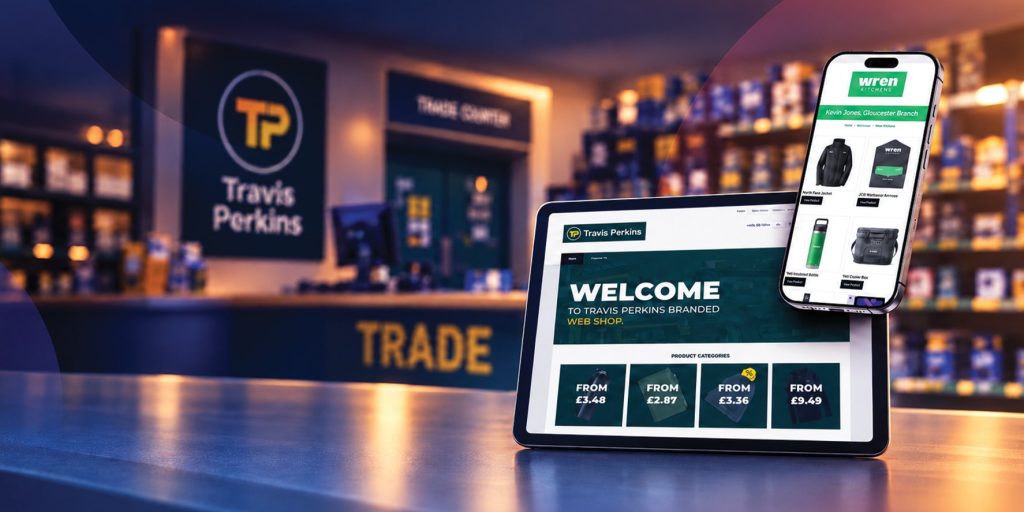
A corporate webshop, sometimes called a company store or swag store, is a branded ordering platform holding a pre-approved range of products. Your team order from it directly, within permissions you set, and fulfilment happens behind the scenes from held stock or print on demand.
The important word is approved. A portal is fundamentally a control mechanism with a shop front on it. If you do not need the control, you do not need the portal.
The signals that say yes
More than one person raises merchandise orders. This is the single strongest indicator. One buyer with good judgement does not need a portal. Six people ordering independently across three departments absolutely do, because that is where inconsistency comes from. You want everyone in the same branding.
You reorder the same items repeatedly. Portals work on repeatability. If your core range is stable and reordered through the year, held stock and self-service ordering make sense. If every requirement is genuinely new, there is nothing to hold.
Teams are spread across sites, branches, regions or countries. Distributed ordering is where local sourcing creeps in and brand consistency quietly degrades.
You have franchisees, dealers or resellers using your brand. These are the hardest groups to control by policy alone, because they are not your employees. A portal makes the approved route the easiest route.
Apparel with sizing is involved. Sizing is admin-heavy by nature. Collecting sizes through a portal instead of a spreadsheet removes an entire category of error.
Budget needs controlling at user or department level. Allowances, spend caps and approval routing are things a portal does well and email does badly.
Onboarding or recognition runs on a schedule or a trigger. If new starters or milestones generate merchandise requirements, that flow can be triggered rather than requested. Learn more about our employee recognition programmes
Someone senior has asked what you spend on merchandise and you could not answer quickly. That question tends to arrive once and then keep arriving. You’ll want somewhere to be able to access the important questions being asked.
The signals that say not yet
- You place a handful of orders a year, all through one person
- Every requirement is a bespoke campaign with no repeat range
- Nobody owns merchandise internally, so nobody would maintain the range
- You have not settled your brand guidelines, so an approved range would be obsolete in six months
- Your total annual merchandise spend is small enough that the admin saved would not cover the structure
None of these are permanent. Most organisations cross into portal territory as they grow headcount, sites or franchise partners.
Matching your order profile to the right model
| Your situation | Likely right model |
| One buyer, a few orders a year, no repeat range | Order as needed against agreed pricing; no portal |
| One buyer, regular repeat orders of core items | Held stock and agreed range, ordered directly with your account team |
| Several order-raisers, one or two sites | Simple portal with a tight approved range |
| Many sites, branches or depots | Portal with location-level permissions and consolidated distribution |
| Franchisees, dealers or resellers | Portal with brand-locked range and self-pay at point of order |
| Remote or hybrid workforce receiving kits | Portal with home-address fulfilment and kitting |
| Global teams across multiple regions | Portal with regional stockholding and local fulfilment |
This is a guide to the conversation rather than a rule. Volume, frequency, geography and how much control you need all pull in different directions, and the right answer is usually a version of one of these rather than an exact match.
What a portal will not fix
Worth being blunt about, because portals get oversold.
- It will not choose your range for you. A portal full of the wrong products is a faster way to order the wrong products.
- It will not create demand. If your teams do not currently want merchandise, giving them a shop will not change that.
- It will not survive without an owner. Someone internally needs to take own the range and review it, ideally annually. Without that it goes stale within a year.
- It will not remove the need for judgement on big campaigns. Launches, events and bespoke gifting still need a conversation, not a basket.
- It will not fix bad brand assets. If your logo files are a mess, they will be a mess on the portal too.
Questions to answer before anyone builds anything
Quick checklist: pre-build decisions
- ✓Who owns the range internally, and who reviews it?
- ✓Who is allowed to order, and up to what value?
- ✓Does anything need approval before it ships, and by whom?
- ✓Who pays: central budget, department cost centre, or the user?
- ✓Which items are held as stock and which are produced to order?
- ✓Do you need home-address delivery as well as site delivery?
- ✓Which countries need to be served, and from where?
- ✓What reporting do you need, and who reads it?
- ✓How often will the range be reviewed, and by what process?
Get these settled first. Almost every portal that disappoints does so because one of these was left vague at the start.
How JSM runs this for a client
Stock or print on demand?
Once you have decided a portal makes sense, the next decision is what sits behind it. Held stock ships immediately and is the right answer for core items with predictable demand. Print on demand avoids tying up capital and avoids dead stock, at the cost of a production lead time on every order.
Most working programmes use both: a small core range held in stock through stockholding and fulfilment, with the long tail produced to order. If that decision is the one you are wrestling with, our guide to stock versus on-demand fulfilment goes into it properly.
FAQs
How many employees do you need before a webshop is worth it?
Is there a minimum spend for a corporate webshop?
Can employees pay for their own items?
What happens to stock if we close the programme?
Can the shop be triggered from our HR system?
Not sure whether a portal is right for you?
Tell us how you order merchandise today and we will tell you honestly whether a webshop would help.