Digital Ad Spend Vs Branded Merchandise: What You Get For Your Money
Every marketing budget review reaches the same moment. Digital spend is a measurable, so it gets defended with numbers. Merchandise spend is harder to justify, so it gets described as brand building and is often the first to face budget cuts.
That is a reporting problem rather than a performance problem. This guide sets out what the published research actually says about the cost of a branded merchandise impression, what a digital impression costs in B2B, why the two are not directly comparable, and how to measure merchandise well enough to defend it properly.
Start with the caveat
An impression from a branded fleece and an impression from a display ad are not the same unit. One is a served ad, counted whether or not anyone registered it. The other is a modelled estimate of how many times a physical object was seen over its life, based on survey data. Anyone claiming a clean like-for-like comparison is overstating it. It’s a lot harder to compare.
What the comparison is genuinely useful for is order of magnitude. The gap between the two is large enough that the methodological fuzziness does not close it.
What the research says about merchandise
The 2026 ASI Global Advertising Impressions Study surveyed nearly 5,000 consumers across the US, Canada, Mexico and Europe. Its headline findings:
A typical promotional product generates around 3,300 brand views over its lifetime
The average cost per impression across promotional products is $0.006, six-tenths of a cent
A $6 tote bag generates roughly 5,000 impressions, giving a cost per impression of about $0.001
Premium items such as fleece average $0.004 per impression or less, because they generate thousands of impressions over a long life
85% of consumers remember the advertiser who gave them a logoed product
78% keep promotional products because they find them useful
76% say they are more likely to do business with a brand that gave them branded merchandise
78% view a brand more favourably after receiving a promotional item
The study also found that promotional products outranked television and digital as consumers’ preferred advertising channel. Figures are quoted in US dollars because that is how the study reports them.
Worth noting on the sustainability side: joint ASI and PPAI research found that promotional products deliver brand recall with a carbon impact per memorised impression around eight times smaller than digital advertising. If you have carbon reporting obligations, that is a more interesting number than it first appears.
What the research says about B2B digital
Published 2026 benchmarks for B2B digital advertising vary enormously depending on sector, geography and how narrowly you target. Broad ranges from several sources:
LinkedIn CPM commonly falls somewhere between $30 and $60 per thousand impressions for typical B2B targeting, which works out at roughly $0.03 to $0.06 per impression
Narrow targeting pushes it considerably higher. Senior-title, large-company audiences are frequently quoted well above that, and ultra-narrow audiences higher again
LinkedIn CPC benchmarks generally sit around $5 to $12, with financial services, SaaS and technology at the upper end
Cost per lead ranges are wide, commonly quoted between $50 and $200
These are ranges rather than facts about your account. Your own historical data beats any published benchmark, and if you are running paid campaigns you already have better numbers than these.
The comparison, with its limitations attached
Branded merchandise
B2B digital display or social
Cost per impression
Fractions of a cent (ASI: $0.006 average)
Typically several cents; higher with narrow targeting
Impression quality
Physical, repeated, often in the recipient’s own hands
Served in feed, frequently unviewed or scrolled past
Duration
Months to years from a single purchase
Ends when the budget stops
Targeting precision
Only as good as your distribution list
Very high, by title, company and behaviour
Attribution
Weak by default; improvable with effort
Strong and immediate
Speed
Production and shipping lead time
Live within hours
Testability
Slow and expensive to iterate
Fast, cheap, endlessly testable
Reach beyond the recipient
Yes, everyone who sees the item in use
Only the impression you paid for
The honest summary: digital wins on precision, speed and attribution. Merchandise wins on cost per impression, duration and the fact that people keep it voluntarily. They are complements, and the argument for treating them as competitors is mostly an artefact of how budgets are structured.
Where merchandise genuinely loses
It cannot be targeted at people you have no route to. No merchandise programme reaches a cold list. Digital does.
It cannot be turned off. A bad creative decision in a paid campaign is a wasted week. A bad merchandise decision is 2,000 units in a warehouse.
It cannot be A/B tested at any sensible cost.
It has a lead time. Reactive campaigns are digital’s territory. Long leads times can mean you’re too late.
Any case for merchandise that skips these is not a case, it is a pitch.
How to measure merchandise properly
Merchandise attribution is weak by default, not by necessity. Most of the gap is a measurement design problem.
Model your own cost per impression using your actual unit costs and a defensible view of item lifespan. A £4 notebook used daily for a year is a very different number from a £4 pen lost in a fortnight, and modelling it yourself is more persuasive than quoting an industry average.
Use unique codes or QR destinations per item, per campaign or per event, so you can attribute traffic and enquiries to the item rather than to “brand”.
Track redemption rather than distribution. How many kits were claimed matters more than how many were shipped.
Pull data from your webshop. A corporate webshop gives you order-level data by department, region and item, which is the closest thing merchandise has to campaign reporting.
Survey recipients occasionally. Two questions to a sample of recipients six months after distribution tells you whether items are still in use, which is the entire basis of the cost per impression case.
Track cost per retained item, not cost per unit. An item nobody keeps has an infinite cost per impression, whatever it cost to buy.
How JSM runs this for a client
Rockwool
Rockwool, an 80-year leader in stone wool insulation, needed to unveil NyRock, its most thermally efficient innovation to date, to a specialist audience. Reaching that audience through paid media alone would have been expensive and easy to ignore. A physical, considered launch piece put the product story into the hands of the people who mattered, and stayed there.
There is no correct ratio, and anyone offering one is guessing. A more useful way to think about it:
Quick checklist: which channel for which job
✓Reaching people you have no relationship with yet → digital
✓Rapid testing of messaging and offers → digital
✓Time-sensitive or reactive campaigns → digital
✓Making an existing relationship memorable → merchandise
✓Converting an event conversation into recall weeks later → merchandise
✓Long-run brand presence at low cost per impression → merchandise
✓Onboarding, recognition and retention → merchandise
✓Account-based programmes into named targets → both, sequenced
FAQs
Is branded merchandise really cheaper per impression than digital advertising?
On the published figures, yes, by a wide margin. ASI’s 2026 study puts the average promotional product impression at six-tenths of a cent, while B2B digital CPMs of $30 to $60 imply several cents per impression. The caveat is that the two impressions are counted in different ways, so treat it as an order-of-magnitude difference rather than a precise multiple.
How do you prove ROI on branded merchandise?
Build the measurement in before you distribute. Unique codes or QR destinations, redemption tracking rather than distribution counts, webshop order data, and a follow-up survey to a sample of recipients. Retrospective attribution is very hard; designed-in measurement is not.
Should we move budget from digital to merchandise?
Not as a straight swap. They do different jobs, and digital is the only one of the two that reaches people you have no route to. The more productive question is whether your existing merchandise spend is being wasted on items nobody keeps, because that is where the recoverable money usually is.
What is the lowest cost per impression item?
On ASI’s figures, high-visibility items used in public over long periods: totes, drinkware and apparel. But the item that gets kept matters more than the category. A cheap item that goes in a drawer has no cost per impression worth quoting.
Want to see the numbers for your own programme?
We will help you model cost per impression on your actual range and build measurement into your next campaign.
Meaningful Merchandise Vs Generic Merchandise: Why the Cheapest Items Cost the Most
The cheapest item on the quote is rarely the cheapest item in practise. A pen that fails in a fortnight, a bottle that leaks, a T-shirt nobody wears twice: each of those cost real money, delivered almost no impressions, and left a small negative impression of the brand that paid for them.
This guide covers what separates merchandise people keep from merchandise people bin, how to apply that test before you order rather than after, and how to make a genuinely generic category feel considered without inflating the budget.
What generic merchandise actually costs
The unit price is the smallest part of it.
The wasted spend is total, not partial. An item that is discarded does not deliver a reduced number of impressions. It delivers close to none. You paid the full unit cost for nothing, and the fact that the unit cost was low is not a consolation. It still failed.
It communicates something you did not intend. A cheap item given as a welcome or a thank-you tells the recipient how much thought went into it, or how much you are worth to them. That signal is received whether or not you meant to send it, and will leave a lasting impression.
It creates sustainability exposure. If your organisation publishes environmental commitments, handing out disposable branded plastic is a visible contradiction. It is also the kind of contradiction employees notice first. People will be quick to form an opinion on a matter like this.
It creates dead stock. Items nobody wants do not get used up. They occupy space, get written off, and quietly appear in next year’s budget conversation as evidence that merchandise does not work. And the dead stock will often just end up in the rubbish.
ASI’s 2026 research found that 78% of consumers keep promotional products because they find them useful. Usefulness is the mechanism. Remove it and the whole cost-per-impression case collapses.
What “meaningful” actually means
It is not a synonym for expensive. Meaningful merchandise has four properties, and none of them requires a large budget.
It is useful in the recipient’s actual life. Not useful in principle. Useful for a site engineer, a remote software developer, a franchise owner. The audience determines the item.
It is good enough to keep looking good. The threshold is whether the item still looks presentable after six months of real use. Below that threshold, quality is the whole game. Above it, further spend yields less than you would think.
It fits the moment it marks. A ten-year service award and a trade show giveaway should not be the same object, even if both carry the same logo.
It carries something specific. A name, a date, a team, a project. The specific detail is what turns a branded object into a kept object, and it is usually the cheapest part of the specification.
The keep test
Before you approve anything, answer these honestly. Not aspirationally.
Quick checklist: the keep test
✓Would I use this myself if it had no logo on it?
✓Would I use it in front of someone whose opinion I care about?
✓Will it still look acceptable in six months of normal use?
✓Does it work in the environment the recipient is actually in?
✓If our branding was removed, would this still be a decent product?
✓Does it stand up to what we say publicly about sustainability?
If the answer to any of these is no, the money is better spent on fewer, better items. Half the quantity at twice the quality almost always outperforms the reverse.
Generic and meaningful, side by side
Generic merchandise
Meaningful merchandise
Unit cost
Lowest available
Higher per unit, often lower per retained item
Retention
Low; discarded quickly
High; used until it wears out
Impressions delivered
Few, then none
Thousands over months or years
Effect on brand perception
Slightly negative
Positive and lasting
Waste and sustainability
Landfill risk, reporting exposure
Designed to be kept
Internal reaction
“Why did we bother?”
Requested again by name
Where it still fits
Very high-volume open giveaways where cost per head is the binding constraint
Generic is not always wrong. A high-footfall consumer event with 5,000 unqualified visitors is a genuine cost-per-head problem and a modest item is a reasonable answer. The mistake is applying that logic to a 40-person onboarding programme.
Making a generic category feel considered
Most merchandise categories are generic by default and can be lifted without changing budget brackets.
Notebooks. This category is as generic as it gets, and the difference between a forgettable notebook and one someone uses daily is paper weight binding and cover finish, not price bracket. Our notebooks range is a reasonable starting point for seeing where the quality steps are.
Drinkware. Move from an anonymous bottle to one people would choose themselves. Sizing the range down to two or three approved SKUs usually finds the quality step.
Apparel. Fit and fabric do more than decoration. An unflattering polo in an unpopular cut will not be worn regardless of how well the logo is embroided. People care more about being comfortable, and looking good.
Pens. If a pen is going to be generic, at least make it enjoyable to write with and choose a material that reflects your positioning. A corn-starch or recycled-material pen costs little more and says something.
Presentation. The same items in considered packaging, with a printed card carrying the recipient’s name, read as a completely different gift. This is the cheapest available upgrade and the most consistently skipped. A little can go a long way to leaving a lasting impression.
The decoration method matters here too. Embroidery, engraving and digital print each suit different products, and choosing the wrong one is a common way to make a good product look cheap. Because decoration and print happen in-house, that recommendation comes from the people who will actually produce it.
A caution on over-personalising
Personalisation is powerful and easy to overdo. Individual names on every item across a large programme adds cost, adds lead time, and adds a category of error that is highly visible when it goes wrong. A misspelled name on a welcome gift is worse than no name.
A reasonable middle position: keep the durable items generic to your brand, and personalise the low-cost, low-risk element such as a printed welcome card. You get most of the effect for a fraction of the exposure.
How JSM runs this for a client
Poppulo
Poppulo wanted merchandise that reflected its values of innovation, quality and care rather than a catalogue selection with a logo applied. JSM curated a collection of premium custom-branded items chosen specifically to carry that positioning, which is a different exercise from finding the cheapest item that meets a specification.
Meaningful and sustainable are largely the same conversation approached from different directions. An item designed to be kept is, by definition, not disposable. An item chosen in recycled, organic or FSC-certified material and made well enough to last does two jobs at once.
The credibility risk runs the other way too. Sustainable material on a badly made product is greenwashing with extra steps, because the item still ends up being discarded. Our sustainability approach covers responsible sourcing and lower-impact materials, but the durability decision matters just as much as the material one.
FAQs
Is expensive merchandise always better than cheap merchandise?
No. There is a quality threshold, and it is lower than most people assume. Below it, items get discarded and the spend is wasted. Above it, additional spend buys perception rather than retention. The skill is identifying where that threshold sits for each category, then spending to just above it.
How do we know if our current merchandise is being kept?
Ask. A two-question survey to a sample of recipients six months after distribution will tell you more than any amount of internal debate. If you run a webshop, reorder patterns are a useful proxy: items people request again are items people kept.
Can we make onboarding packs feel personal at scale?
Yes, and it does not require personalising every item. A personalised welcome card, a note from the hiring manager, and something specific to your culture will carry the whole pack. The durable items can stay standard.
What is the single cheapest way to make merchandise feel more considered?
Presentation and a name. Considered packaging and a printed card with the recipient’s name on it costs very little and changes how the entire set is received, and leaves a lasting impression on the recipient.
Ready to stop buying merchandise that gets binned?
We will help you set a quality threshold for each category and build a range people actually keep.
Merchandise doesn’t create a culture within the workplace. If people are leaving, the hoodie will not help, and handing out branded water bottles during a redundancy round is a well-documented way to make things worse.
What merchandise does is make an existing culture visible and shared. It gives people something to belong to, marks moments that would otherwise pass unnoticed, and includes people who are not physically present. This guide covers where that works, where it backfires, and what separates merchandise that reinforces culture from merchandise that quietly undermines it.
What merchandise can and cannot do
It can do this:
Make membership of a team or organisation visible and tangible
Mark shared moments so they are remembered as shared
Include remote and distributed people in things they were not physically at
Give a new starter a sense of having joined something before day one
Make abstract values concrete, when the item genuinely reflects them
It cannot do this:
Compensate for poor management
Substitute for pay, progression or workload relief
Manufacture pride that is not there
Survive a mismatch between what the item says and how people are actually treated
That last point is the one that matters most. Merchandise amplifies. If the underlying culture is good, it amplifies that. If it is not, it amplifies the gap, and employees are extremely good at reading the difference.
Where merchandise genuinely reinforces culture
Onboarding. The first physical thing someone receives from you sets an expectation about how organised, thoughtful and well-run the place is. It arrives before their first meeting and before anyone has had a chance to explain the culture in words. Our guide to new starter kits and onboarding packs covers the specifics.
Shared moments. A project that went well, a difficult period got through, a safety record held, an anniversary of the company itself. An item tied to a specific moment carries that moment for years, and it becomes a reference point people use with each other.
Remote inclusion. This is where merchandise does something nothing else does as cheaply. A distributed employee who receives the same item as everyone else, at the same time, has participated in the thing rather than heard about it afterwards.
Team identity within a large organisation. People belong to their team before they belong to the company. Team-level items, within brand guidelines, tend to be valued more than company-wide ones. To help people feel more seen and appreciated.
Values made tangible. If sustainability is genuinely part of how you operate, merchandise made from recycled or lower-impact materials demonstrates it in a way a policy document cannot. Our sustainability range exists largely for this reason.
Recognition. Covered in more depth in our employee recognition solutions, but worth stating here: recognition is the mechanism by which culture is reinforced repeatedly rather than announced once.
The credibility test
Merchandise carries a claim, whether you intend it to or not. The test is whether the object supports the claim.
What the item is meant to say
What undermines it
We take sustainability seriously
Single-use plastic, unnecessary packaging, an item designed to be thrown away
We care about quality
An item that looks worn out after two months
We value you as an individual
A generic item with no acknowledgement of the person
We are well organised
A gift that arrives after the moment it marks
We are inclusive
Apparel that only comes in a narrow size or fit range
We are a premium brand
Merchandise noticeably cheaper than everything else you produce
None of these gaps require malice. They happen because merchandise decisions get made under time pressure by people focused on cost per unit. But employees read the object, not the intention.
Apparel is where culture lives, and where it fails
Apparel does more for culture than any other category, because it is worn in public and by choice. It is also the category most often got wrong.
Fit and cut matter more than decoration. An unflattering garment will not be worn, however well the logo is embroidered. Offer proper fits rather than one unisex cut and hope.
Size range is an inclusion issue. A range that stops at XL excludes people visibly and publicly. Extend it.
Give a choice where you can. Two or three garment options, ordered by the individual, produces far higher wear rates than a single item distributed to everyone.
Apply the outside-work test. Would someone wear this at the weekend? If yes, you have bought culture and thousands of impressions. If no, you have bought a garment for the back of a wardrobe.
Get the logo size right. Restrained branding gets worn. A chest-width logo does not.
Quick checklist: culture-building merchandise
✓Something people would choose to own without the logo
✓Available in a size and fit range that includes everyone
✓Tied to a specific moment, team or achievement
✓Delivered to remote staff at the same time as everyone else
✓Consistent with what your organisation says publicly about itself
✓Ordered often enough that people are not still wearing the 2019 version
✓Good enough quality to still look right in a year
What actively undermines culture
Merchandise as a substitute. Items handed out during pay restraint, restructuring or excessive workload are read as an insult, correctly.
Visible tiering. Senior staff receiving noticeably better merchandise than everyone else says something you probably do not want said.
Excluding remote staff, or including them late. Two weeks later is a different message from the same day.
Items nobody can use. Desk accessories for a workforce without fixed desks. Golf umbrellas for people who commute by bike.
Inconsistency. Four suppliers, four interpretations of your brand colour, and a stand where nothing matches. It reads as an organisation that does not pay attention.
Overdoing it. Merchandise every month becomes wallpaper. Reserve it for moments that mean something.
How JSM runs this for a client
St James’s Place
St James’s Place runs a multi-order merchandise programme built around quality, consistency and brand alignment. At that scale, with multiple orders across a long-running relationship, the value is less in any single item and more in the fact that everything matches, meets the same standard, and reflects the brand the same way each time. Consistency over years is what turns merchandise into a cultural constant rather than a series of unrelated purchases.
The practical failure mode is drift. Different offices source locally, ranges change with whoever is ordering, and within two years there is no recognisable standard across teams or offices.
Approve a core range of products and keep it stable between annual reviews
Centralise fulfilment so nobody is sourcing substitutes independently
Run ordering through a corporate webshop so teams choose from approved items rather than starting from scratch
Hold stock of core apparel so a new starter never receives a substitute because of a supplier delay
Collect sizes properly, once, and keep them
FAQs
Can branded merchandise really improve company culture?
It can reinforce a culture that already exists, and it’s one of the few tools that includes distributed people in shared moments at low costs. It cannot create a culture where there isn’t already one, and it will make an existing problem more visible if it’s used to paper over the cracks in the team.
What is the best branded item for building culture?
Apparel, provided it is something people would actually wear. It is worn publicly and by choice, which means it signals genuine affiliation rather than compliance. The condition is fit, quality and an inclusive size range.
How often should we give employees branded merchandise?
Tie it to moments rather than a calendar. Onboarding, anniversaries, project completions and company milestones give you a natural rhythm. Merchandise handed out for no particular reason stops registering.
How do we include remote employees properly?
Ship to home addresses as standard rather than as an exception, and time delivery so remote staff receive items at the same time as office staff. If something is being handed out at an all-hands, the remote version should already be on the doormat.
Our teams keep ordering their own merchandise. How do we stop that?
Make the approved route easier than the unapproved one. Teams source locally because it is faster, not because they want off-brand items. A portal with a good range and quick fulfilment removes the incentive.
Ready to make your culture visible?
We’re on hand to help you build a core range that people actually want to wear, and keep it consistent as your company grows.
A corporate webshop is not a saving in itself. it’s a mechanism, and like any mechanism it can be set up in a way that pays for itself many times over, or set up in a way that just relocates the same problems onto a nicer interface.
The difference is usually decided in the first month, before anyone has ordered anything. This guide covers where the return actually comes from, the five levers that move it, the mistakes that quietly erode it, and what to measure so you can prove it.
Where the return actually comes from
Most webshop business cases lead with unit price. That is usually the smallest component. The return comes from five places, in roughly this order of size:
Recovered admin time. The hours currently spent quoting, raising purchase orders, transferring artwork, approving proofs, chasing deliveries and processing invoices. This is nearly always the largest saving and nearly always the one nobody has measured, because it is distributed across people whose job is something else entirely.
Reduced waste. Fewer emergency orders at short-run pricing, fewer over-orders placed to hit a price break, less dead stock written off. Waste reduction usually outperforms negotiated discounts as a source of savings.
Consolidated volume pricing. Real, but secondary. It matters because the shop makes total category spend visible, which is what allows it to be priced properly in the first place.
Consistency, which prevents rework. Items that match do not need replacing because they clash. Artwork held once does not get reproduced badly.
Impressions retained rather than wasted. A curated range means fewer items nobody keeps. Spend that produces no impressions is the most expensive spend on the ledger, whatever the unit price was.
The five levers
Lever
What it does
What to watch
Range discipline
Fewer, better SKUs; higher volume per line; better pricing; less dead stock
Pressure to add items; resist between annual reviews
Stock versus print on demand
Held stock ships instantly; on demand avoids tied-up capital
Getting the split wrong in either direction
Spend controls
Allowances, caps and approval routing stop budget leaking
Controls tight enough to obstruct legitimate ordering
Consolidated distribution
One picking and shipping operation rather than several
Shipping cost per order on very small orders
Data and reporting
Shows what is used, by whom, at what cost
Reports nobody reads and therefore nobody acts on
Setting it up so it pays
Curate hard. Twenty to forty well-chosen SKUs beats two hundred that are randomly selected. A large range fragments volume, ties up capital, generates dead stock and makes ordering slower rather than faster. Every additional line has to justify itself.
Decide the stock split deliberately. Core items with predictable demand should be held. Long-tail and seasonal items are better produced to order. Getting this wrong in either direction is expensive: too much stock is capital and write-off risk, too little is a lead time on every order. Our guide to stock versus on-demand fulfilment works through the trade-off.
Set permissions by role, not by seniority. The question is what someone legitimately needs to order, not how senior they are. Over-restricting is the most common cause of people going around the shop.
Collect sizing data once. Apparel sizing is where administrative time goes to die. Capture it in the shop and stop asking.
Set reorder triggers, not reminders. Replenishment should be driven by stock levels and managed by your supplier, not by someone noticing a shelf is empty. This is what stockholding and fulfilment is for.
Name an internal owner. One person who owns the range and reviews it annually. Shops without an owner are the ones that look tired in eighteen months.
Baseline before you launch. Record current order volume, average lead time, spend by category and the approximate admin hours involved. Without a baseline you will not be able to demonstrate the improvement, and someone will eventually ask.
The mistakes that erode ROI
Too much range. The single most common failure. It looks generous and behaves expensively.
No owner. The range goes stale, then people stop using the shop, then it becomes evidence that portals do not work.
Over-ordering to hit price breaks. A discount on stock you never distribute is not a discount.
Controls so tight that people work around them. If the approved route takes four days and a local supplier takes one, you have not solved the sourcing problem, you have just moved it out of sight.
No review cycle. Annually is usually right. Constant change confuses people; never changing produces a range full of items nobody wants.
Treating the shop as the whole solution. Major campaigns, launches and bespoke gifting still need a conversation with someone who knows what they are doing.
Not using the data. The reporting is one of the biggest advantages of running a shop, and it is routinely ignored.
Quick checklist: a webshop set up to pay for itself
✓A curated range of 20 to 40 SKUs, reviewed annually
✓A deliberate split between held stock and print on demand
✓Permissions and spend caps set by role
✓Sizing data captured in the shop
✓Supplier-managed replenishment with reorder triggers
✓One named internal owner
✓A recorded pre-launch baseline
✓Home and site delivery both available as standard
What to measure
Orders per month and unique users. Utilisation is the first indicator. A shop nobody uses cannot deliver anything.
Average time from order to delivery. Should drop sharply against your baseline for held-stock items.
Admin hours per order. Estimate honestly before and after. This is where the case is won.
Spend by department and region. The visibility that was impossible before.
Stock turn by SKU. Identifies lines to drop at the annual review.
Off-shop sourcing incidents. How often people go around the shop, and why. Each one is diagnostic.
Dead stock written off. Should fall as range discipline improves.
Modelled cost per retained impression. Ties the programme back to marketing value rather than only to procurement savings.
How JSM runs this for a client
Jewson
Jewson operates over 500 branches as one of the UK’s largest builders merchants. At that scale the return does not come from unit price negotiation, it comes from removing hundreds of individual sourcing decisions and replacing them with one approved route. Branches order what they need from a controlled range, and the stock, artwork and distribution are handled centrally rather than reinvented locally.
A webshop is excellent at repeat, predictable, self-service ordering. It is not the right mechanism for a product launch, an exhibition build or a significant client gifting programme. Those need judgement, and trying to force them through a basket produces worse outcomes than picking up the phone.
The strongest programmes run both: the shop handles the ninety per cent of orders that are routine, which frees your account team and your internal owner to think properly about the ten per cent that are not.
FAQs
How do you calculate ROI on a branded webshop?
Take the admin hours per order before and after, priced at a realistic internal rate, and add reduced waste, reduced emergency ordering and any consolidated volume pricing. Compare that against the cost of the programme. The reason most business cases understate the return is that they only count unit price.
How long before a webshop pays for itself?
It depends on order volume and how much admin you were carrying before. Organisations with many order-raisers across many locations tend to see it quickly, because that is where the wasted hours are concentrated. Low-frequency, single-buyer organisations may not reach the threshold at all, and it is worth establishing that before building anything.
How many products should be in a corporate webshop?
Fewer than instinct suggests. Twenty to forty SKUs covers most requirements. Beyond that you fragment volume, tie up capital and slow ordering down, which are the three things the shop was meant to fix.
Should we hold stock or produce on demand?
Usually both. Hold the core items with predictable demand so they ship immediately; produce the long tail to order so you are not carrying capital in slow-moving lines. The split is worth revisiting at each annual review as demand patterns become clearer.
Who should own the webshop internally?
Whoever owns brand or people operations, depending on what the shop is mostly for. What matters is that it is one named person with the authority to say no to range additions, and time set aside for an annual review.
Ready to build a webshop that pays for itself?
We will help you curate the range, set the stock split, and give you the reporting to prove the return.
Event Merchandise and Giveaways: What to Take, What to Skip
Event merchandise has two jobs, and most stands only plan for the first. The first is getting people to stop. The second, harder job is being remembered three weeks later when the person is back at their desk with forty new business cards and no recollection of which conversation was which.
Items that do the first job are cheap and plentiful. Items that do the second are the ones worth budgeting for. This guide covers how to tier giveaways so both jobs get done, what actually works at B2B events, the logistics that catch people out, and what to do with what is left over.
The two jobs, and why tiering solves both
A single giveaway cannot do both jobs. Something cheap enough to hand to everyone will not be memorable; something memorable enough to be kept cannot be handed to everyone within budget. Tiering resolves this.
Tier one: open giveaway. Available to anyone who approaches. Its purpose is stopping people and starting conversations. Cost per head is the binding constraint, but it still has to be something people take willingly.
Tier two: qualified conversation. Given after a genuine conversation, or in exchange for a scan or a contact detail. This is the tier that does the remembering job, and it is where most budget should go. It should be good enough that someone would be mildly disappointed to lose it.
Tier three: booked meeting or named target. A small number of high-value items for people you specifically wanted to meet, often delivered after the event rather than at it. Post-event delivery is underrated: it arrives when the person is back at their desk and the competition for attention has gone.
Premium drinkware, personalised item, considered gift box
Stand team apparel
£20–£45 per person
Team size plus spares
Polo, fleece or softshell, consistent across the team
Brackets vary with item choice, decoration method, volume and personalisation. Use them to frame the budget conversation and check current pricing for what you actually intend to order.
What works at B2B events
Something useful during the event itself. A tote, a lanyard, a phone charger. It gets used on the floor, which means your brand walks around the hall for two days.
Something with genuine desk longevity. A good notebook or a bottle that lives on a desk delivers impressions for years, which is where the cost per impression case is won.
Something tied to the product story. Merchandise that references what you actually do is remembered as being from you, rather than as being from a stand.
Consistent team apparel. Often the highest-impact spend on the whole stand and the most frequently overlooked. A team that looks like a team reads as an organisation worth talking to. Our sales and events ranges cover this.
A reason to come back. Something claimed later in the day or at a demo, giving you a second conversation.
What to skip
Anything that will not fit in hand luggage. International attendees leave it behind, which wastes the unit and looks bad on the table at the end.
Very cheap plastic. It gets taken and binned in the same building. You paid for it and it delivered nothing.
Anything requiring explanation. If the value is not obvious in two seconds, it will not stop anyone.
Novelty items with no use. Taken out of politeness, discarded at the hotel.
Food, unless you have checked properly. Allergens, dietary requirements and heat all cause problems.
Anything that contradicts your sustainability position. Events are where this happens most often and where it is most visible. Our sustainability range exists partly for this reason.
The logistics that catch people out
Artwork and production deadlines are earlier than you think. Work backwards from the event date, not forwards from today, and add contingency for a proof revision. Personalisation and unusual decoration methods extend this.
Shipping to the venue is not the same as shipping to an office. Most venues have specific delivery windows, an advance warehouse, an on-site handling charge, and rules about what they will accept and when. Missing a delivery window can mean your stock sits in a compound until after the event.
Have a plan B for stock. A box in the hotel or in a team member’s car has rescued more stands than anyone admits.
Quantities: over-order the cheap tier, under-order the expensive one. Running out of tier-one items on day one is a visible failure. Having tier-two items left over is fine, because they keep.
Decide the leftover plan before the event, not after. This is where event merchandise waste comes from. Items that could serve a purpose later end up in a cupboard because nobody decided in advance.
Quick checklist: event merchandise timeline
✓Confirm event date, stand size and expected footfall
✓Set tiers and quantities against realistic conversation volume
✓Confirm artwork deadline with your supplier and work backwards
✓Approve pre-production samples, especially for anything personalised
✓Check venue delivery windows, advance warehouse and handling charges
✓Arrange a backup box held separately from the main delivery
✓Brief the stand team on which tier goes to whom
✓Set up tracking: unique codes, QR destinations or scan-to-claim
✓Decide in advance where leftover stock goes
Measuring event merchandise
Events are one of the easier places to attribute merchandise, because distribution is a discrete moment.
Give each tier its own QR destination or discount code, so you can see which tier produced follow-through
Track items claimed against conversations logged, which tells you whether the tier-two threshold was set correctly
Record how much of each tier was distributed rather than how much was shipped
Follow up with a small sample of tier-two recipients a month later and ask whether they still have the item
None of this is difficult, but all of it has to be set up before the event. Retrospective attribution at events is close to impossible.
How JSM runs this for a client
Rockwool
Rockwool needed to unveil NyRock, its most thermally efficient insulation innovation, to a specialist trade audience. The challenge with a launch of that kind is that the technical story is the whole point and easy to lose in a busy hall. The merchandise was built around the product story rather than being a generic giveaway with a logo applied, so what people took away carried the message rather than just the brand.
List it on your corporate webshop so sales teams can draw on it for client visits
Roll tier-two items into onboarding packs or recognition gifts, provided they are not event-dated
Avoid dating items in print unless the date is genuinely the point, because an undated item can be used for two years
Book the next event’s requirement against remaining stock before ordering anything new
If you run several events a year, this is the single largest saving available. Most organisations buy fresh for each event while holding usable stock from the last one, because nobody has visibility of what is left.
FAQs
How many giveaways should we order for a trade show?
Work from expected qualified conversations rather than total footfall for the tier-two items, and be generous on tier one so you do not run out early. If the organiser gives a footfall figure, remember that only a fraction will approach your stand. Ordering to hold the balance as stock for the next event removes most of the risk from getting this wrong.
What is the best giveaway for a B2B trade show?
For the open tier, something useful during the event itself: a tote, a good pen, a notepad. For the qualified tier, something with desk longevity such as a quality notebook or drinkware. The best item is the one that is still in use a month later, because that is when your follow-up is landing.
When do we need to place an event merchandise order?
Earlier than the production lead time suggests, because artwork approval, sample sign-off and venue delivery windows all sit on top of it. Tell your supplier the event date at the first conversation and let them work backwards, and treat anything personalised as needing extra time.
Should we ship merchandise to the venue or the hotel?
Usually the venue, via its advance warehouse if it has one, but check the delivery window, the handling charge and what the venue will accept. Whichever you choose, keep a small backup quantity with the team rather than relying entirely on a single delivery.
What do we do with leftover event stock?
Hold it centrally, make it visible on your webshop, and use it for client visits, onboarding or the next event. The mistake is leaving it in an office cupboard, where it becomes invisible and gets replaced by a fresh order.
Planning an event?
We will help you tier your giveaways, hit the artwork deadlines, and hold what is left for next time.
Why is the Owala Bottle Trending, and Should it be in your Merchandise Range?
For years a branded water bottle was the safe, forgettable choice. Then reusable drinkware turned into a category people had opinions about, queue for, and post about. Stanley got there first, Owala followed, and now employees ask for specific brands by name.
That changes the calculation for anyone buying merchandise. This guide covers why Owala look off, what the trend actually tells you about buying branded drinkware, whether a trend-led bottle is the right call for a corporate programme, and how to get the same effect without chasing whatever happens to be viral this quarter.
What is Owala, and why did it take off?
Owala is a drinkware brand launched in 2020 by Trove Brands. Its signature product, the FreeSip, uses a lid that lets you either sip through a built-in straw or tilt and drink from a wide opening, with a push-button release and a locking carry loop.
That single feature explains most of the trend. Reusable bottle specifications had converged: almost everything in the premium bracket is double-walled stainless steel, insulated and leak-proof, so nothing on the spec sheet stood out. The FreeSip lid gave people something to notice, and crucially something that could be demonstrated in a three-second video. Owala has said the #owala hashtag has passed 272 million views on TikTok. By 2023 the brand had reached the top of US water bottle sales.
The colour releases did the rest. Owala runs bold, named colourways in limited drops, which turns a functional object into something closer to an accessory, particularly among younger buyers.
What the trend tells you about buying branded drinkware
Setting Owala aside for a moment, the underlying lessons apply to almost any merchandise decision.
One demonstrable feature beats a longer spec list. People do not compare wall thicknesses. They notice a lid that works differently.
Recognisability is a feature. A shape and colour people can identify across a room does more for perceived value than a better-quality but anonymous product.
The recipient’s own social proof does your marketing. A product people already want to own gets used in public without any prompting from you.
Trend is not the same as longevity. The reason to pick a trending item is that people will keep it, not that it is trending. Those usually overlap, but not always.
Owala as branded merchandise: the practical realities
Co-branded Owala is available through the promotional trade, typically the FreeSip bottles in 24oz and 32oz, the FreeSip tumblers and the SmoothSip range. Decoration is usually screen print or laser engraving onto the powder-coated finish. There are a few things worth knowing before you commit:
Minimums are usually set per colour, not per order. Because the appeal is the colourways, buyers often want a spread, and each variant carries its own minimum. A 200-unit order across six colours behaves like six small orders.
Availability moves. Trend-brand stock is allocated, and a colour that was available at quotation may not be available at order. Build in an approved alternative before you go to artwork.
Branding is deliberately restrained. Premium drinkware brands limit logo size and placement, and keep their own mark on the product. If your brand guidelines require a dominant logo, a trend brand is the wrong route.
It sits in the premium bracket. Expect to pay several times the cost of a standard promotional bottle for a branded name-brand equivalent, and check current pricing at the quantity you actually need.
UK availability is thinner than in the US. Much of the co-branding programme activity for these brands is North American. Lead times into the UK are worth confirming before you promise a date internally.
Trend brand, premium brand or standard promotional drinkware?
Option
Typical position
Where it works
What to watch
Trend brand (Owala, Stanley)
Premium, recognised, colour-led
Recognition gifts, senior client gifting, recruitment and campus, wellness programmes
Colour-level minimums, restricted branding area, stock allocation, cost per head
Established premium brand (Ocean Bottle, Chilly’s and similar)
Large volumes, onboarding packs, site and field teams, events
Needs genuine quality to survive the keep test; cheap drinkware is worse than none
Positioning here is indicative and shifts with product choice, decoration method and volume. Treat it as a way to frame the decision rather than a price list, and check current pricing for the specific items and quantities you have in mind.
Quick checklist: when a trend-led bottle is the right call
✓The audience is small enough that per-unit cost is not the binding constraint
✓The item is meant to feel like a reward rather than a supply
✓Your brand is comfortable sharing the product with another brand’s mark
✓You have a single ordering moment rather than a rolling requirement
✓You can accept a longer lead time and an approved fallback colour
Quick checklist: when to go a different route
✓You need thousands of units at a predictable cost per head
✓The bottle has to survive a factory, site or field environment
✓Brand guidelines require a dominant logo and controlled colour
✓ You need continuity of supply over two or three years
✓You are shipping internationally to multiple regions
The durability question
Trend products are designed for offices, gyms and commutes. They are not always designed for a shop floor. If a bottle is going to be dropped onto concrete, cleaned industrially or knocked around in a van, durability matters more than how the lid opens and closes the lid mechanism, and it is worth asking for a sample and testing it in the actual environment rather than trusting a specification.
This is where a supplier who holds and tests stock earns its keep. Sourcing a recognised brand is straightforward. Knowing which drinkware survives your particular environment is the part that takes experience.
Keeping drinkware from becoming an admin problem
Drinkware is where merchandise ranges tend to sprawl. Colours multiply, sizes get added, and within eighteen months you have eleven variants and no idea which ones move.
Approve a short list of two or three drinkware SKUs and stick to it between annual reviews
Hold stock of the core item rather than reordering each time, so a gift is never delayed by a production run
Run ordering through a corporate webshop so teams and regions pick from the approved range rather than sourcing their own
Let stockholding and fulfilment handle replenishment, rather than someone in marketing keeping a mental note of what is running low
If sustainability is part of your positioning, make sure the drinkware supports it. Our sustainability range covers recycled and lower-impact options.
FAQs
Can you get Owala bottles branded with a company logo?
Yes. Co-branded Owala is available through the promotional trade on selected models, usually decorated by screen print or laser engraving. Branding areas are restricted and the Owala mark stays on the product, so it is co-branding rather than white labelling. Minimums and availability vary by model and colour, so it is worth checking current stock before committing to a colourway.
Is a trending bottle worth the extra cost over a standard branded bottle?
It depends entirely on the purpose of the water bottle. For a recognition gift or senior client gift, where the point is that the recipient values the object, the premium usually justifies itself. For a thousand-unit onboarding programme, a well-chosen quality bottle at a third of the cost will be kept, and used just as reliably.
What is the alternative to chasing drinkware trends?
Buy for the keep test rather than the trend. Pick drinkware people would choose for themselves, in a finish that stays looking good, and let the fact that it gets used daily do the work. A well-specified bottle delivers impressions for years, whether or not it was trending when you bought it.
How many colours should we offer?
Fewer than you want to. Every additional colour is a separate minimum, a separate stock line and a separate thing to run out of. Two or three is usually plenty, and a single colour that perfectly aligns with your branding can be the perfect choice, to help keep consistency.
Ready to get your drinkware range right?
We’re on hand to help you choose the right drinkware that survives your environment, holds your brand properly and gets kept.
The humble notebook is still one of our most popular branded products. There are so many styles, colours and branding options to choose from so how do you know what to go for?
Here we take look at the different types of branding you can choose for the cover of your notebooks, so you can find the right option for you.
Branding for your notebooks
Print: Full colour printing directly onto your notebook cover or pages for vibrant, detailed designs.
Debossing: Raised impressions pressed into the cover for a tactile, elegant finish.
Foil block: Shimmering metallic foil stamped onto the cover for a luxurious, eye-catching look.
Belly bands: Custom printed wraps that encircle your notebook for branding or gifting.
Printed tip-in pages: Extra custom pages inserted inside the notebook for messages, branding or artwork.
Gifted boxes: Premium presentation boxes designed to elevate your notebook as a thoughtful gift.
We also offer many other ways of customising your notebook such as:
Additional printed page inserts – a great way of adding additional information about your company, calendars or important dates or advertising pages.
Belly Bands / Book Wraps – these are printed paper wraps that go around the outside of your notebook and offer an opportunity to add contact information, slogans, or to promote a certain theme or event.
Packaging – why not gift your notebook in a bespoke gift box, you can also add other products to your box if you wish. Or we can add them to individual notebook card envelopes or sleeves.
Add a branded pen – you need a pen to write in your notebook! Why not add a complimentary printed pen for the perfect notebook gift set.
Whichever finish you choose, the right branding treatment turns an everyday notebook into a piece of merchandise people actually keep and use, which means your logo stays front of mind long after the meeting, conference or induction day is over. Ready to talk through the options for your next notebook run? Get in touch with our team and we’ll help you find the perfect finish.
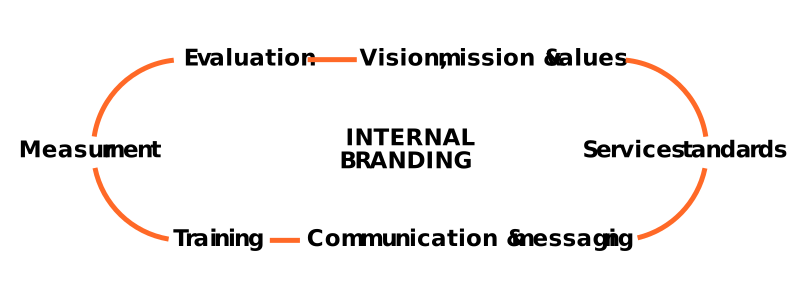
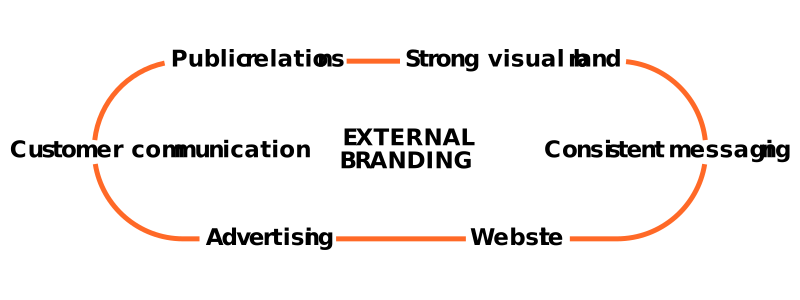
Internal vs External Branding
First, let’s define the difference:
Internal Branding: It’s all in the name really. This relates to everybody inside the company. It is the connection that employees feel to the company, its mission and values.
External Branding: This is the image that your company puts out to the world via all its marketing/communications channels. If this is strong it will attract new customers and business, as well as retaining the current client base.
So is one more important than the other?
The short answer is No! For the most effective growth of new customers is to aim to have a solid foundation in both. To have strong internal branding will help to strengthen the external branding and vice versa.
So how to ensure that both are strong and supporting each other. Below are some points.
Internal branding:
Define your company’s mission and values. What are the principles that guide your business? What do you stand for?
Communicate your mission and values to your employees. Make sure that everyone in the company knows the mission and values, and that they are aligned to them.
Create a positive work environment. Providing a safe, healthy, and supportive workplace where employees feel valued and respected will help to boost employee loyalty and connection.
Celebrate successes. When employees achieve something great, make sure to recognise and celebrate their success, give them pride in their work. And make sure that it’s not only just internal knowledge, share it with the world.
External branding:
Develop a clear and consistent brand identity. So really, your company’s name, logo, colours, and tagline.
Create marketing materials that communicate your brand message. This is your many channels of communications, so your website, brochures, advertising, and social media posts.
Provide excellent customer service. This is where internal and external really meet. It’s one of the best ways to build a positive reputation for your company. And this can be affected by anyone from the first to the last point of contact (even if that last point of contact is a package or box).
Get involved in your community. Show that you care about the people and places where you do business. It will make you appear authentic, which in this social media age, is critical.
Conclusion
So yes, both are important to get right in conjunction with each other to ensure that your reach, attraction and nurturing of prospects (and customers alike) helps to grow your business. Ready to bring your internal and external branding together? Get in touch with our team and we’ll help you find the perfect fit.
Is Branded Merchandise Really Lower Carbon Than Digital Advertising?
Digital marketing is often seen as the ‘greener’ option. No physical products. No shipping. No materials. But recent international research is starting to challenge that assumption. New studies comparing marketing channels have found that the carbon footprint of promotional products can be lower than digital advertising when measured per impression, especially per memorised impression. That’s a significant shift.
For brands investing in sustainable marketing, it reframes the conversation entirely. It’s not just about what you use, but how effectively it works. For companies looking at how best to get their name in front of potential customers and clients, there’s much to consider when it comes to where best to put their efforts in line with corporate responsibility.
The Study Behind the Headlines
Global research into advertising sustainability has taken a more informed approach to measuring impact. Instead of looking at total emissions alone, the study analysed:
Full life-cycle carbon impact
Production, distribution, and usage
Carbon per impression, and crucially, per memorised impression
The key takeaway? Promotional products can deliver a lower carbon impact per meaningful engagement than many digital formats. Why? Because they last longer, get used repeatedly, and stay visible over time.
Why Branded Merchandise Performs So Efficiently
The efficiency of branded merchandise comes down to one thing. Longevity. Unlike digital ads that disappear in seconds, a well-chosen product can stay with someone for months, or even years. Items that share your strong brand identity. Products that customers use daily. Or a unique momento that holds pride of place in a home or office.
What this means for your business is repeated brand exposure, higher recall, and greater engagement over time. A single product doesn’t equal one impression. Instead, one well-chosen product can deliver hundreds, even thousands, of impressions over its lifetime. This is where branded merchandise sustainability becomes a strategic advantage, not a compromise.
It’s Not Just About Carbon, It’s About Longevity
Sustainability isn’t just about emissions. It’s about usefulness. A high-quality, premium product becomes part of someone’s routine. A reusable water bottle used daily, a notebook carried to every meeting, or a piece of apparel worn regularly. They’re considered marketing that becomes something people rely on. This is the difference between eco-friendly branded merchandise and throwaway items. Produced properly, branded merchandise delivers a stronger brand connection, but also a lower environmental impact over time.
Where Sustainability in Branded Merchandise Is Won or Lost
In every merchandise discussion and brainstorm, there are many elements to consider in terms of budgets, timelines, outreach and return on investment. But it’s important to remember that not all merchandise is created equal. The difference between effective, responsible campaigns and wasteful ones comes down to some essential decisions.
Product Choice
The most important question. Will people actually use this? The best sustainable promotional products are those that stay in use. Useful products outperform novelty items, reusable items outperform disposable ones, and everyday relevance drives long-term impact.
Quality Over Quantity
More isn’t better. Quality is better. Low-cost, high-volume giveaways often have short lifespans, get discarded quickly, and deliver minimal long-term value. In contrast, fewer well-made items last longer, deliver more impressions and reduce overall environmental impact. This is where sustainable corporate gifts outperform bulk giveaways.
Sourcing and Materials
Consumers care about how products are made. That’s why sustainable campaigns should consider recycled or responsibly sourced materials, ethical production standards, and reduced transport distances. For UK brands, working with a promotional products supplier such as JSM enables more transparent supply chains, reduces shipping emissions, and provides better control over quality. Local sourcing plays a key role in sustainable giveaways for UK strategies, because it matters to the end user.
Why ‘Cheap Merch’ Is the Real Problem, Not Merchandise Itself
How often have you been to an event, conference or been handed a piece of merchandise that you thought was inherently wasteful? The issue isn’t branded merchandise, it’s poorly chosen branded merchandise. This is where the reality is different, and misconceptions may be had. Low-cost items often have a short lifespan, go unused, and are discarded quickly, ending up in landfills, which damages both sustainability and brand perception. Execution is key. When brands prioritise quality and relevance, the outcome changes completely from both a commercial and environmental impact.
How Leading Brands Are Rethinking Promotional Products
Forward-thinking brands are already shifting their approach. No longer are they looking at bulk giveaways. Instead, they’re investing in thoughtful onboarding kits, sustainable corporate gifts, and campaign-led merchandise that has a clear purpose. This shift reflects a broader trend of quality over quantity, impact over volume. Creative teams are thinking outside of the box with strategic branded merchandise ideas with products that are aligned to their brand ethos and customer needs, with an edge that hasn’t been seen before.
A Smarter Way to Approach Sustainable Marketing
All marketing channels have an environmental impact. Digital isn’t impact-free and physical products aren’t automatically wasteful. The real question is ‘Which approach delivers the most value for efficiency and effectiveness?’ When measured this way, branded merchandise performs strongly, particularly when it’s used regularly, built to last, and strategically deployed, moving the focus away from assumptions and onto outcomes.
How to Make Branded Merchandise More Sustainable
For national campaigns, partnering with a promotional products UK supplier ensures better oversight and alignment with your sustainability goals. The result is an eco-friendly branded merchandise collaboration that delivers on both performance and responsibility. For brands looking to improve their approach, the principles are clear:
Choose products people will actually use
Prioritise durability over cost
Avoid over-ordering
Work with experienced suppliers
Consider supply chain transparency
What makes a promotional product sustainable is a simple yet successful framework. An item that is used regularly, built to last, responsibly sourced, and relevant to the audience. If your product meets these criteria, then it’s far more likely to deliver long-term value.
What This Means for Your Next Campaign
The takeaway is simple: Don’t write off branded merchandise on sustainability grounds. Instead, focus on its relevance, longevity and quality. When approached strategically, branded merchandise can be one of the most efficient and effective tools in your marketing mix. E-commerce and digital campaigns can be supported by physical products that extend engagement beyond the screens, which make it an exciting time to delve into exploring what’s possible.
The narrative in this field is changing, and there are key drivers for impact and accountability. Merchandise isn’t the high-impact option it’s often assumed to be, the real difference comes down to how it’s executed. The latest research shows a more nuanced reality. When measured properly, promotional products can deliver a strong marketing performance with a lower carbon footprint than expected. The real difference comes down to how they’re used.
At JSM, we believe that better products create better outcomes for brands and for the environment. Done properly, branded merchandise isn’t just impactful, it’s responsible. Could your merchandise be working much harder? If you’d like to find out more, contact us for ideas or call us on 01452 310030.
Manage Consent
To provide the best experiences, we use technologies like cookies to store and/or access device information. Consenting to these technologies will allow us to process data such as browsing behaviour or unique IDs on this site. Not consenting or withdrawing consent, may adversely affect certain features and functions.
Functional
Always active
The technical storage or access is strictly necessary for the legitimate purpose of enabling the use of a specific service explicitly requested by the subscriber or user, or for the sole purpose of carrying out the transmission of a communication over an electronic communications network.
Preferences
The technical storage or access is necessary for the legitimate purpose of storing preferences that are not requested by the subscriber or user.
Statistics
The technical storage or access that is used exclusively for statistical purposes.The technical storage or access that is used exclusively for anonymous statistical purposes. Without a subpoena, voluntary compliance on the part of your Internet Service Provider, or additional records from a third party, information stored or retrieved for this purpose alone cannot usually be used to identify you.
Marketing
The technical storage or access is required to create user profiles to send advertising, or to track the user on a website or across several websites for similar marketing purposes.